

Upcoming Summer Classes
Plus a comedic novel reading list in honor of my newest class!

Check out my first post here to read more about the namesake of this newsletter and make a copy of the input/output tracking sheet if you so desire.
Summer session, let’s go! One-off classes (all recorded if you can’t attend live, class slides sent in recap):
Mine Your Life for Funny Ideas, Saturday, June 6th, 1-3pm ET (online, $99)
In this two-hour interactive and generative workshop, students will complete lists and brainstorming prompts to gather specifics and interesting ideas hidden in plain sight. After generating the raw material, we’ll experiment with comedic foundations and tools like exaggeration, templates, and twists to create premises and titles for future funny writing.
Testimonial:
“I took Caitlin’s Mine Your Life for Funny Ideas seminar hoping to build a more intentional foundation for my comedy writing, and the class far exceeded my expectations! The level of engagement was incredibly helpful. Forming ideas firsthand in the workshop gave me a solid grasp of her tools and processes, and a sense of confidence I previously lacked. I can’t wait to continue future training and workshops with Caitlin!” —David
How to Write a Short Humor Piece, Saturday, July 11th 1-3pm ET (online, $99)
In this two-hour class you’ll learn a repeatable process for writing a short humor piece in the style of McSweeney’s Internet Tendency, The Belladonna, Points in Case, and other online sites (note: we will not cover satirical news like The Onion or Reductress). You’ll learn how to brainstorm, find a structure for your piece, craft a strong comedic premise and title, and use the two-list system of joke writing to fast draft a humor piece.
And my new class!
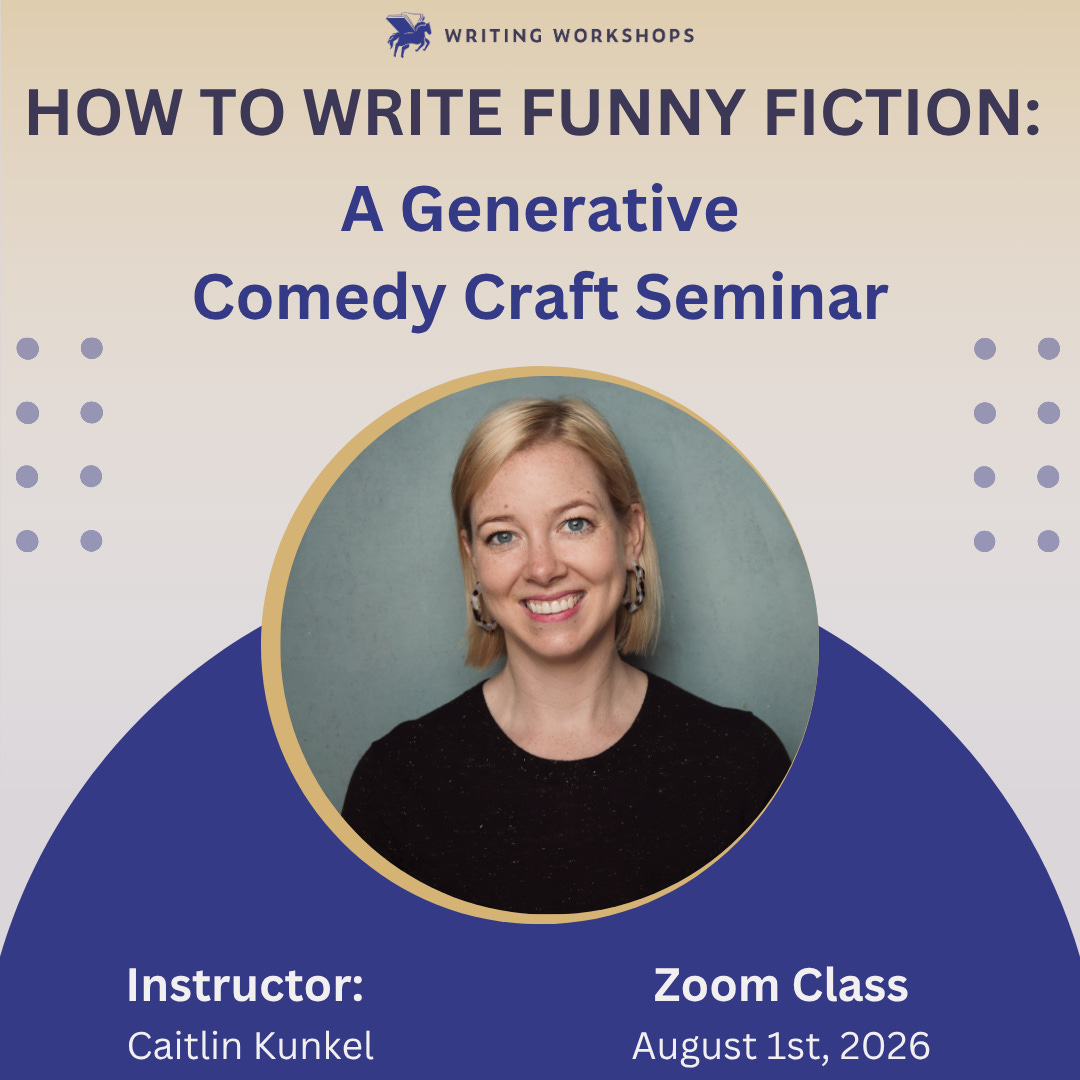
How to Write Funny Fiction, Saturday, August 1st, 1-3pm ET (online, $99)
In this two-hour generative Zoom seminar, I’ll break down how to make your fiction laugh-out-loud funny, from your premise to your protagonist to your line-level writing. The class opens with an overview of comedic novel subgenres: speculative, hyperreal, satirical, dark, and absurd. From there, we’ll move into the elements of a high-concept comedic premise and learn the questions and techniques that help bake comedy into a novel or short story idea from the start.
The seminar also covers comedic protagonists in fiction, with a focus on how contradiction and irony can wring comedy out of your characters’ thoughts and actions. The final segment zooms in on the levers you can pull to write funny at the scene and line level: setpieces, character interiority, description, and dialogue. Throughout, I’ll draw on advice from the interviews I conducted with comedic novelists for Inside Jokes, along with examples from contemporary comedic novels and short fiction.
I’ve long kept a comedic fiction reading list, and I’ll keep expanding on it leading up to the class (participants will receive the entire list with over 100 titles after the class).
Here’s a teaser of books from the comedic subgenres to get your brain going (and many books cross subgenres):
In hyperreal fiction, you exaggerate one element, such as a plot point, a character trait, or setting. The hyperreal element is outside our normal world but normal in the world of the novel. In the satirical novel Made for Love by Alissa Nutting, a brain chip (does not exist in our world…yet) is inserted in the main character by her billionaire tech husband in the first-ever human “mind-meld.” The technology is the hyperreal element. Comedic speculative fiction also fits in this category, such as The Husbands by Holly Gramazio.
For a novel or short story to be satirical fiction, the premise must have a clear target and point of view. In the short story “Friday Black” from the collection of the same name by Nana Kwame Adjei-Brenyah, a salesperson battles violent, zombie-like shoppers in a department store, which satirizes and targets our culture of rabid consumerism. (note: I’m working on a post about how “satirical” is misused in book marketing these days)
In absurd fiction, a character reacts normally to a situation, but the situation is ridiculous. In Sara Levine’s novel The Hitch, the protagonist must seriously deal with her nephew being possessed by the spirit of a corgi named Hazel—an absurd problem that requires a real solution.
Surreal fiction has the quality of a dream. In a surreal world, lunchboxes can have personalities and driver’s licenses. Surreal stories often use portals or thresholds to enter alternate dimensions. In the short story “Terrace Story” by Hilary Leichter, a portal appears in a family’s small Manhattan closet that leads to a terrace they’ve never seen before—a manifestation of a New York real estate dream. But accessing the magical terrace too often sets off a chain reaction that changes their family and the larger world.
Dark comedic fiction juxtaposes sinister, heavy, or taboo topics and situations (like murder) with moments and scenes of lighter comedy. In My Sister, the Serial Killer by Oyinkan Braithwaite, the protagonist Korede helps her serial-killer sister Ayoola move a victim from the crime scene (sinister). As they load the body into an elevator, a woman with a child calls for them to hold it. Ayoola goes to push the “doors open” button, and Korede reminds her sister they are disposing of a body and can’t hold the elevator (lighthearted).
Drop your favorite comedic novels (and what subgenre you think they fit into) into the comments so we can make a summer reading syllabus!
ABOUT ME: Caitlin Kunkel is a funny writer, teacher, and speaker. She co-founded the The Belladonna Comedy, created the online satire writing program for The Second City, and serves as a judge for The Thurber Prize for American Humor. She co-wrote the gift book New Erotica for Feminists: Satirical Fantasies of Love, Lust, and Equal Pay, named one of the 10 best comedy books of the year by Vulture. Her second book, INSIDE JOKES: A COMEDY AND CREATIVITY GUIDE FOR ALL WRITERS is out October 20, 2026.
Wrequiem at the Red Rocks, brutalist satire
This one's a little on the nose, but I *just* replaced my copy of Peter Farrelly's (one of the filmmaking brothers!) THE COMEDY WRITER. And I recently begged a friend to read Mike Albo's THE UNDERMINER: THE BEST FRIEND WHO CASUALLY DESTROYS YOUR LIFE. Strong recommends all around.